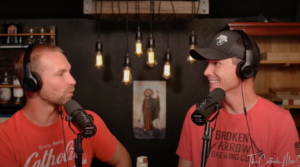
Right before a break, one of us asked Father Bethel a question we hear all the time. Why does God speak to us in silence? He could have picked any language. It sure would be great if he just told us exactly what he wants for our lives. One of us admitted that this is probably him, and that he has said so out loud before.
He Did Speak
Creation and Scripture
Father Bethel started by pushing back a little. God did speak to us, he said, first through creation and then through his Word, especially Scripture. But both of those lead us toward silence, because God is greater than anything he says.
He pointed to the words “I am who am”, spoken to Moses. There is so much depth in them that Jesus took them up again. Jesus said people would know “I am” once he was lifted up. That points to the same mystery. We can’t fully embrace it, even though God gives it to us.
One Word
Father Bethel then turned to St. John of the Cross. As he put it, the Father says only one Word, and that Word is himself. Our little words help us enter that one Word. We just call it silence for now. We get it in pieces, and each piece helps us understand a bit better.
That is also why we have poetry and liturgy. When ordinary speech runs out, we still need something to carry us.
Why He Doesn’t Just Send an Email
Then came the second half of the question. Why doesn’t God simply tell us what he wants? Father Bethel said he obviously doesn’t. One of us added that it’s not like he sends an email.
Instead, he wants us to search for him. St. Paul prays that we would have a sense of God’s will, which means we have to look for it. We are human beings with free will and judgment, and God wants us to live that way. Father Bethel added that one reason people become monks is to see more clearly what they’re supposed to do. He admitted it’s harder out in the world.
Meditation Gives You Arrows
We asked how meditating on God’s transcendence can be a kind of silence. Our own thoughts in prayer are noisy, and the contrast surprised us. Father Bethel said that is the whole goal of his book. We meditate a lot in order to arrive at a silent, loving gaze toward God.
He told the story of St. Thomas Aquinas, who wrote the Summa and never finished it. His secretary said, “Thomas, we’ve got work to do.” Thomas replied that he could write no more. After what he had seen, everything he had written was straw. Even so, he got there by doing the work first.
Father Bethel said our thoughts act as arrows pointing toward God’s greatness. God is good, and he really is good, but he is better than we can grasp. So we build up all these true thoughts and then bring them together in one silent gaze.
Francis and a Few Words
He gave us a picture of St. Francis of Assisi. A young man traveled with Francis and stayed awake to see what he did at night. Francis, thinking his companion was asleep, got up and prayed. He said only a few words, “My Lord and my all.” Yet his whole life was in them.
Even silent prayer often includes a few words to keep the gaze going. That is what meditation is for. It gets us to the point where a few words are enough.
Will Heaven Be Silent or Full of Song?
Near the end, we asked whether heaven is silent or full of singing. Father Bethel said both. He compared it to our liturgy, where the whole mystical body of Christ praises God together. At the same time, it is also love and looking at him. He quoted John of the Cross again, saying the Father speaks one Word in absolute silence. Our answer to that Word, Father Bethel said, would be the most beautiful word possible.
He was honest that he doesn’t know how much of heaven will be words as we use them now. What he does believe is that the ultimate silence is a beautiful music of creation answering God’s love. Sound and silence arrive at once, and both are perfect.
Father Bethel’s answer made heaven a little easier to imagine, and one of us called that real progress. For more from this conversation, listen to the full episode.